

"Hathorkare's Curse": The Stolen Queen by Fiona Davis
- Abigail McFadden
- May 8, 2025
- 3 min read

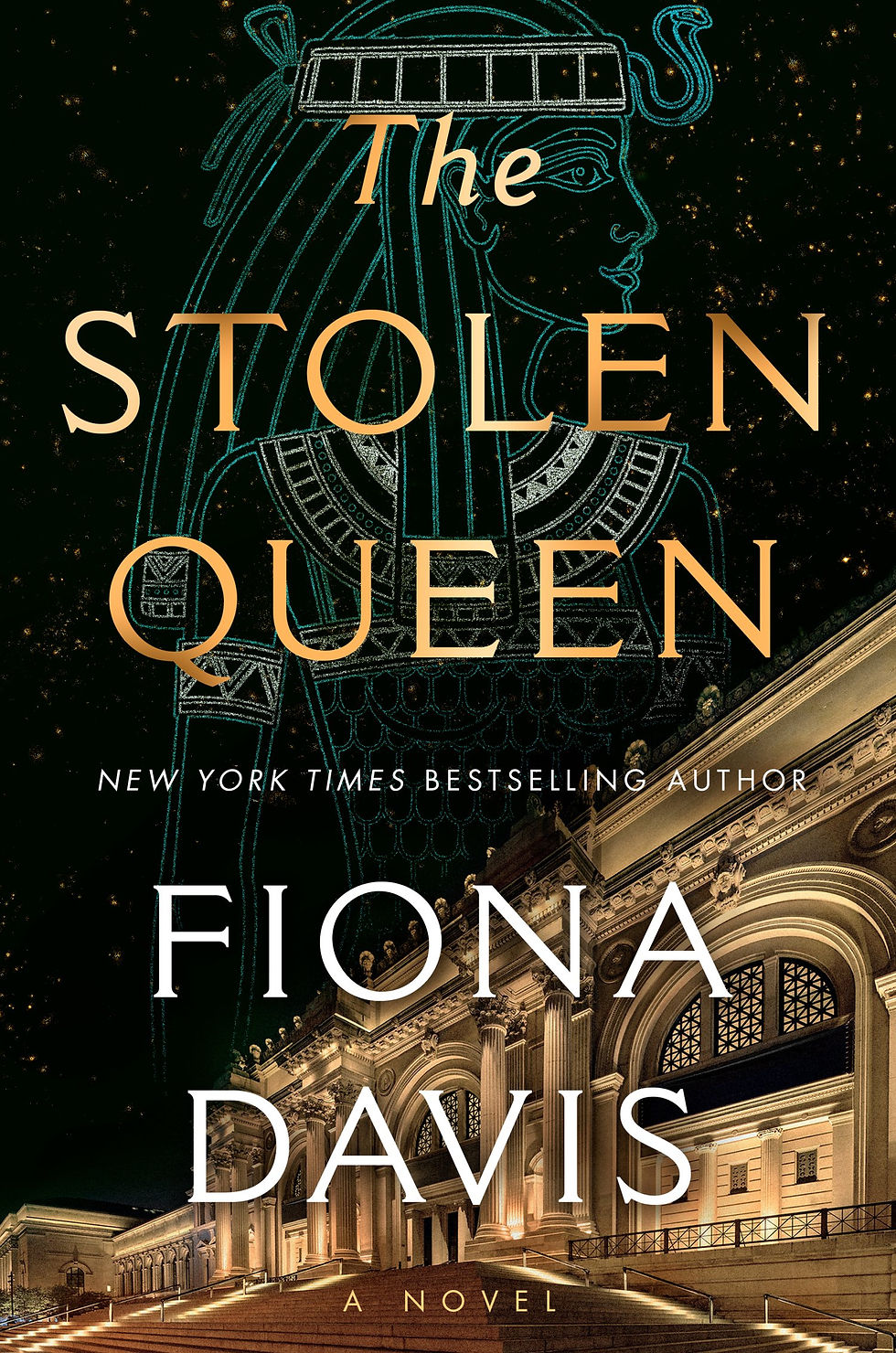
The Stolen Queen was written by Fiona Davis. While writing this book, she did quite a lot of research on both Egyptology and the time periods that the book takes place in.
Egypt, 1936: When anthropology student Charlotte Cross is offered a coveted spot on an archaeological dig in Egypt’s Valley of the Kings, she leaps at the opportunity. But after an unbearable tragedy strikes, Charlotte knows her future will never be the same.
New York City, 1978: Nineteen-year-old Annie Jenkins is thrilled when she lands an opportunity to work for iconic former Vogue fashion editor Diana Vreeland, who’s in the midst of organizing the famous Met Gala, hosted at the museum and known across the city as the “party of the year.” Though Annie soon realizes she’ll have her work cut out for her, scrambling to meet Diana’s capricious demands and exacting standards.
Meanwhile, Charlotte, now leading a quiet life as the associate curator of the Met’s celebrated Department of Egyptian Art, wants little to do with the upcoming gala. She’s consumed with her research on Hathorkare—a rare female pharaoh dismissed by most other Egyptologists as unimportant.
That is, until the night of the gala. When one of the Egyptian art collection’s most valuable artifacts goes missing . . . and there are signs Hathorkare’s legendary curse might be reawakening.
As Annie and Charlotte team up to search for the missing antiquity, a desperate hunch leads the unlikely duo to one place Charlotte swore she’d never return: Egypt. But if they’re to have any hope of finding the artifact, Charlotte will need to confront the demons of her past—which may mean leading them both directly into danger.
Of all these books, this one felt the most like a possible Indiana Jones book. I really did enjoy the two characters, they both felt very interesting to me. Charlotte Cross and Annie Jenkins were compelling with their different motivations, and I was very invested in the story.
Davis leans into the era of Egyptology, where many of the people around the world became incredibly invested in the discoveries in Egypt. Obsessions with Egypt began in the late 18th century, though the most famous discovery was in 1922 of King Tutankhamun. This is a very prevalent topic in the book, especially as both characters are directly involved with the Metropolitan Museum of Art, which would be set to host the King Tut exhibit in the 1970s portion of the book, and Charlotte went to Egypt around 14 years after that discovery.
Cross works as an assistant curator, and in both the 1936 and 1978 periods had to deal with bouts of sexism from the male archaeologists and Egyptologists. The more archaeological part of the book comes in the second half, when Charlotte and Annie make their way to Egypt, even if it does somewhat take a backseat to figuring out who stole the Cerulean Queen. The parts of archaeology featured are super interesting to me, especially regarding the way that Davis uses Hatshepsut as her basis for Hathorkare.
There is also a discussion regarding the repatriation of artifacts and who gets to “own” history. Charlotte has to reckon with her feelings of ownership regarding the gallery at the Met that she oversees. There is also discussion about the museums in the local area, specifically the Egyptian Museum, and if they can take care of the artifacts in their possession. This is a common discussion with international repatriation, though Davis doesn’t dive too deep into it.
At the end of the book, Davis provides a list of books for further reading by the audience, some of which I will share here:
Egypt’s Golden Couple: When Akhenaten and Nefertiti Were Gods on Earth by John Darnell and Colleen Darnell
Empress of the Nile: The Daredevil Archaeologist Who Saved Egypt’s Ancient Temples from Destruction by Lynne Olson
Hatshepsut: From Queen to Pharaoh edited by Catharine H. Roehrig with Renee Dreyfus and Cathleen A. Keller
The mystery of who stole the Cerulean Queen is an incredibly journey, and the curse turns out to not be a curse. Cross is able to reunite with the family she lost while in Egypt, and Annie finds her calling. Davis does an incredible job of writing about Egypt, and using the information she found in her research to create a realistic sounding replacement of Hatshepsut.


Comments